Learn
Blind Golf Scoring — How to Score a Missing Player
A blind is a scorecard placeholder for a player who didn't show up, letting your group finish a format that needs a full foursome. Here's how to score one fairly, which convention to use, and how to run it on a phone without a calculator.
When you'd use a blind
You don't need a blind every time someone bails — you can just play the threesome. You need one when the format requires a specific number of players and you can't change it on the fly. The three most common situations:
- League week with a no-show. Most team leagues are scored as foursomes. If one teammate doesn't show, the remaining three still need to post a team score, and the missing player gets a blind.
- Threesome that wants to run a foursome game. Skins, 2 v. 2 best ball, and Vegas all assume four players. Rather than switch to a threesome format, you drop a blind into the fourth spot and keep playing the game you planned.
- Weekend buddy group with an odd number. Five guys, three teams of two is awkward. Five guys, two teams of two plus a blind on each side is clean.
The four common scoring conventions
Leagues and groups handle blinds four different ways. Pick one before the round — not after — so no one can argue it later.
1. Net par (recommended)
The blind's net score equals par on every hole. On a par 4, they're a 4. On a par 5, they're a 5.
2. Field average
The blind's score on each hole is the average of the field's score on that hole. Requires everyone to finish before you can post the team.
3. Best-ball phantom (always par)
In a 2 v. 2 best-ball, the blind posts par gross on every hole. Because best ball takes the team's lowest score, the blind almost never counts — they're a floor, not a real contributor.
4. Lowest available
The blind inherits the lowest score their remaining teammates post on each hole.
Why net par is the standard
Three reasons net par wins almost everywhere it's written down:
- It's symmetric. A blind on Team A and a blind on Team B each post the exact same score on every hole. Neither team gains an edge from the missing player.
- It's fast. You don't need to wait for the field to finish or look up anyone else's scores. Blind = par, every hole, done.
- It matches the handicap system's intent. A net-par round is a scratch performance — what a handicapped player is expected to shoot. Scoring the blind at net par treats the phantom as a league-average golfer, which is closer to the truth than any alternative.
Step-by-step example
You're on a par 4. It's the 12th handicap hole. Your missing teammate carries a 12 handicap index and would have gotten a stroke here. What does the blind score under each convention?
| Convention | Gross | Net | Notes |
|---|---|---|---|
| Net par | 5 | 4 | Par + 1 stroke = 5 gross, minus 1 for the stroke = 4 net = par. |
| Field average | Depends | Depends | Say the field averaged 4.6 on this hole — the blind posts that. |
| Best-ball phantom | 4 | 4 | Blind always posts par gross. Never counts unless the team's real players both score worse. |
| Lowest available | = teammate | = teammate | Whatever the blind's remaining teammates post, the blind matches. |
Tournament vs casual rules
USGA-sanctioned events and most organized leagues specify the blind convention in their local rules — check your league handbook or ask the handicap chair before the round. In casual games, just say "we're using net par for the blind" at the first tee and you'll avoid the argument on the 18th green.
If you're running a charity scramble or a member-guest where a player drops out, most pros default to net par and post a team score. That's the safest call.
Common mistakes
- Double-counting strokes. Net par already accounts for the blind's handicap. Don't give them an extra stroke on top.
- Forgetting to net. If your game is gross-only (stroke play, low gross), the blind's gross score matters — net par only works for net competitions.
- Blind winning a skin. Most groups rule that a blind can't win a skin; if the blind posts the low net, the skin carries to the next hole. Decide this before you start.
- Not announcing the convention. "Net par" sounds obvious to you and baffling to your buddy. Say it out loud on the first tee.
How to run a blind in Settle Up Golf
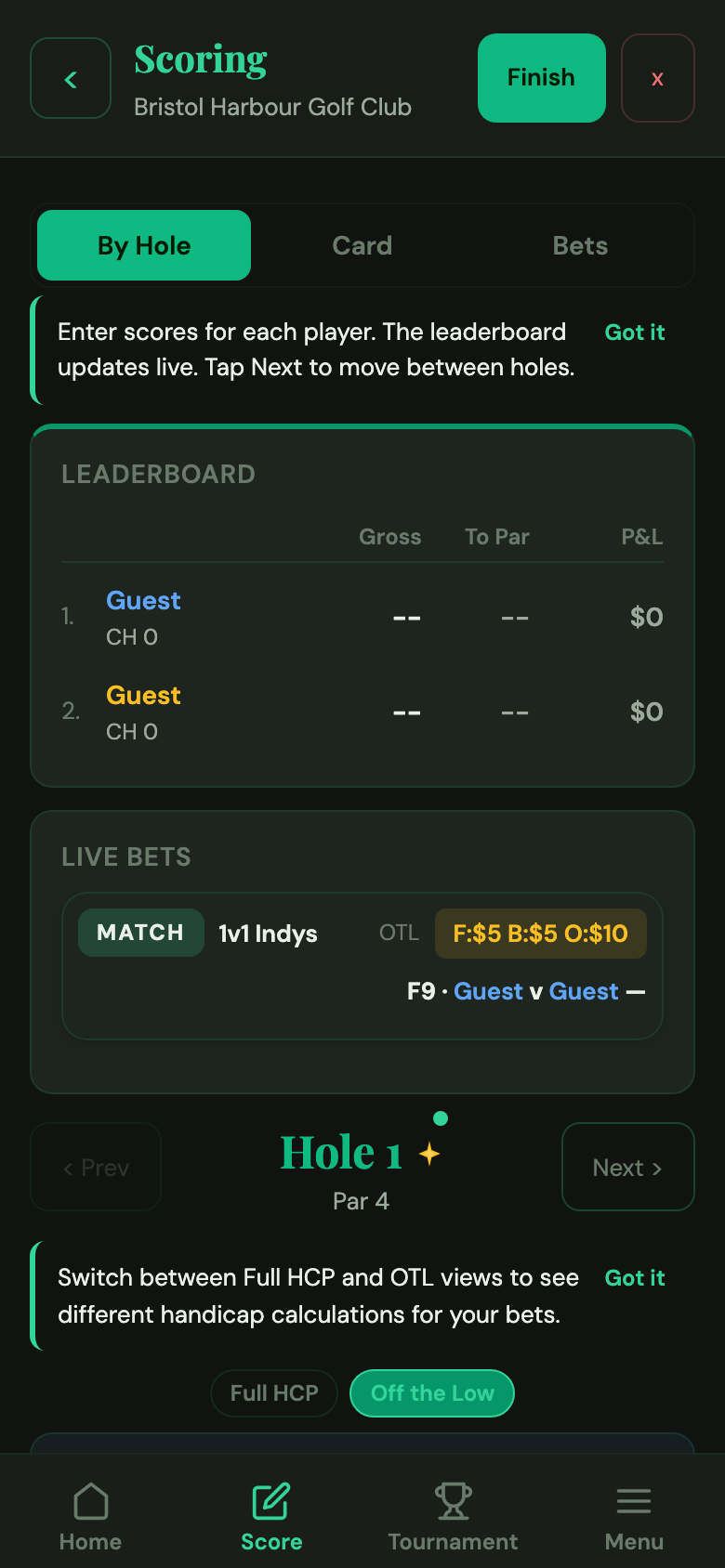
The app doesn't have a dedicated "blind" mode, but the Guest player feature handles it in one step. Add a Guest named "Blind" with a handicap index of 0, then manually enter par on every hole as you play.
Because the Guest's handicap is 0, they get no strokes anywhere on the course. Gross par = net par, so a par entry on every hole gives you exactly the net-par convention with zero math.
FAQ
Can a blind win money in our game?
Most groups don't let a blind win money. If you're running skins and the blind posts the low score, the skin usually carries. Decide before the round.
Can a blind win a skin?
By convention, no. The blind's score is a placeholder, not a competitor. If the blind would have "won" a skin, the skin carries to the next hole.
What handicap should a blind have?
If you're using net par, the handicap is irrelevant — the blind always nets par regardless. For simplicity in Settle Up Golf, use 0.
Should I announce the convention before or after the round?
Before. Always before. Announcing after the round lets people pick the convention that benefits them, which is the opposite of fair.
Is net par the same as posting par?
Only if the player's handicap is 0. Traditionally, a handicapped player posting "net par" shoots gross par + strokes. In practice, the math works out the same if you set the blind's handicap to 0 and enter par each hole — simpler to execute, identical result.
Run a blind in Settle Up Golf
Use the Guest player feature to drop a blind into any round. One tap, no math.
See the Guest player walkthrough →